The Most Annoying Train Supply Voltage Ever
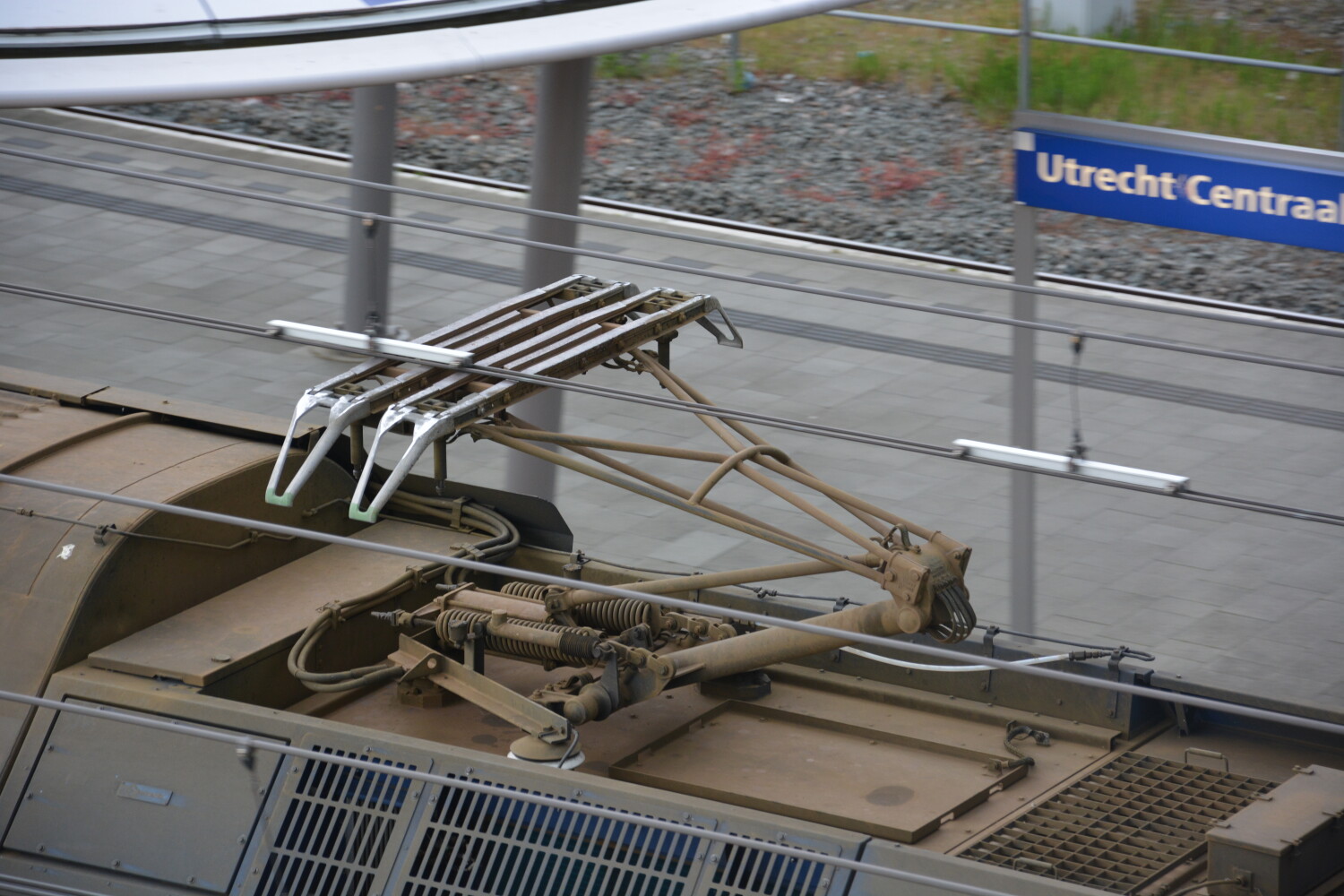
Ok I have a thing that annoys me about dutch trains that actually nobody cares about: the voltage of the overhead wires(1.5 kV).
Now why would I care? Well great question I shouldn't. But its poor voltage costs more electricity. I'll explain:
You have the law P = U * I, or power = voltage * current. Voltage is measured in Volt(V), current in Ampère(A), and power in Watt(W). As you know you need a circuit with a positive and a negative to power something. Current flows from a to b through some kind of conductor.
The conductor has resistance and can only carry so much current. For simplicity, you can think of current as buckets of water, and voltage the amount of water in a bucket. Also, because of resistance, current is "lost" under way which causes heat. This is (I think?) why there is a limit to the current in wires, otherwise the conductor just becomes too hot.
So to increase the power you can increase the current, but you can also increase the voltage(back to the analogy: either more buckets or more water in the buckets). Let's say you want one kilowatt of power, you can either have 10 Volt * 100 Ampère = 1 kW. This wire will probably get very hot and also, to make up for the loss, it in turn draws more current to have the same power, also it usually increases the resistance of the conductor which in turn generates more heat and draws more power, which is a feedback loop, etc.
You can also just put 10000 V * 0.1 A = 1 kW which as you can see, uses a lot less current yet delivers the same power.
Now you might scream in excitement at your screen, just increase the voltage to insane levels and you have practically lossless power delivery! Correct, but there is a catch: if you increase the voltage the electricity has a tendency to "jump" to other conductors, also things that don't conduct that well. An extreme example is lightning which is 300 MVs but you also see it in high voltage power lines. They are far from the ground and far from each other because if you get too close it will zap you. The higher the voltage, the greater the distance required. This is why (among other reasons) you don't have a 700 kV electrical outlet in your house. So there is an optimum.
Now, trains require A LOT of power, and I can tell you that 1.5 kV, or 1500 Volt, is ABSOLUTELY NOT the optimum. It's roughly 6 times the voltage what is coming out of my electrical outlet, yet it might have to carry something like a 1000 times more power. You can see that results in considerable losses as well as being limiting on the capacity of the wires.
Worse, is that the relationship between heat loss and current is not linear, but quadratic. Double the current, quadruple the heat. This means that this pathethic 1.5 kV will yield in tens or even hundreds of times more energy loss than necessary.
Belgium uses 3 kV DC, which is already a lot better. In practice, the Dutch railway lines are overvolted to 1.8 kV as the specs allow for +20% tolerance.
The Dutch railway maintainer has tried in the past to make it 3 kV DC. Ideally you'd do 25 kV AC but that would require a complete rework of all overhead wires, with 3 kV that is not the case.
They say that the trains would accelerate faster which would result in time gains, and by a conservative estimate it would save 19.5% of train power consumption(!!!). That's ~240 GWh. You could power a small city with that. With 2016 electricity prices, it would return its costs for rail infrastructure in about 10 years.ProRail
Also important to consider: it would free up capacity. The Dutch railway system is the busiest in Europe, and there are points where there is a (threat of) too little power.s
From this perspective this seems like a nobrainer, especially in 2016 with the low interest rates. But it would also mean that NS among others would have to convert their trains, which they didn't really like I assume.
Apparently they did a cost/benefit analysis for the entire economy in 2017, and it resulted in being either a loss or a break even to convert it (up to 2070). By far the biggest cost was converting the trains. Though some parts were unquantifiable and I assume if you have a high CO2 or electricity price price it could still be a good idea, and both power and EU-ETS prices have increased since then. Also CO2 has a cost which will last hundreds of thousands of years, but that's hard to quantify.
I guess, it's just a tragedy. Because the Dutch railway system electrified so early, they used this voltage which apparently made sense at the time. Much like the U.S. still uses the bizarre 120 volts. And that's why we spend at least 24% more on electricity than were we a little slower and had 3kV, let alone 25 kV AC.
Apparently the Netherlands isn't the only one with 1.5 kV DC, the south of France uses it as well. Even worse, a part of south England uses 750 Volt 🤮
And then you have Germany with 15 kV AC but then it's 16.7 Hz for some reason.
There is only one good voltage for trains, and that is 25 kV AC 50 Hz.
Bonus: A VIRMm with 6 carriages currently draws 2.312 * 106 W/1800 V = 1284.44 A 💀
If you have 25 kV, it would be 92.48 A.
As for heat production, current has not a linear but a quadratic relationship. An equation derived from Joule's law goes Pheat = I2R Watt or Joule/second.
The energy loss by conversion to heat is in the 1800 V example is ~192.9 TIMES GREATER(heat energy loss is just ~0.52% that of 1.8 kV) compared to 25 kV. Compared to 3 kV, 2.77 times greater(36% of 1.8 kV). Just by overvolting from 1.5 kV to 1.8 kV, they are reducing ~30% of heat.